

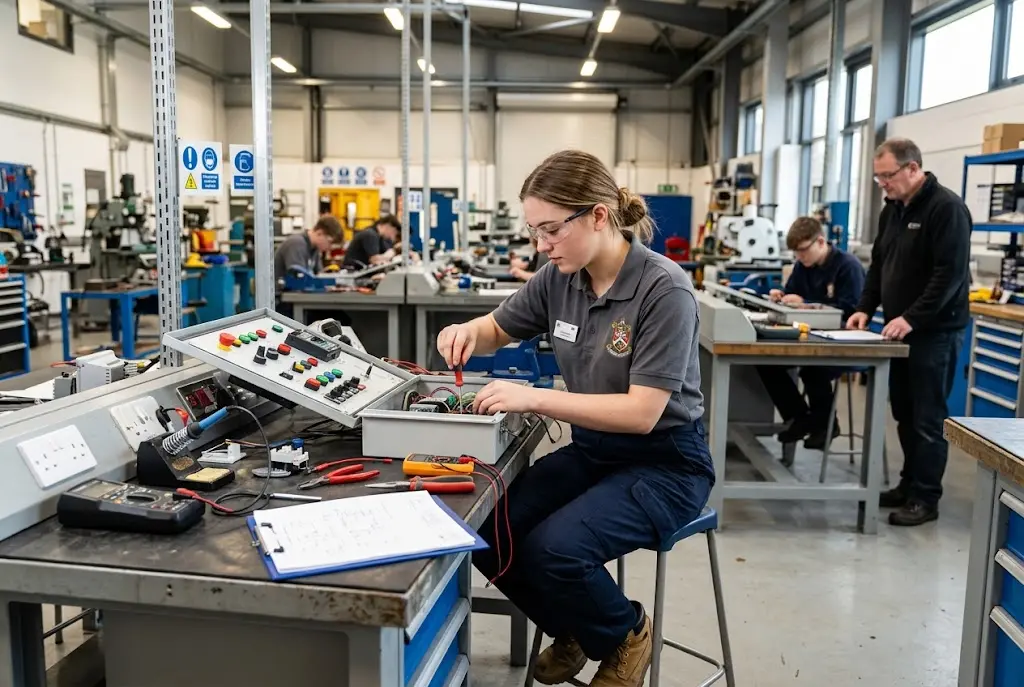
Technician-level study can cover many areas, including engineering, laboratory work, IT, construction, healthcare, science, digital technology and other technical occupations. Because the options can differ significantly in content, entry requirements, practical training and progression routes, it is worth comparing them carefully before enrolling.
This guide explains how to choose a technician-level course in the UK, what to look for in a programme and how to decide whether a technical qualification, T Level, vocational course or apprenticeship is the right fit for your goals.
What Is a Technician-Level Course?
A technician-level course is generally designed to develop practical and technical knowledge for a particular occupation or industry. Rather than focusing entirely on academic theory, these programmes typically place greater emphasis on applying knowledge, using equipment, understanding workplace processes and developing job-related skills.
The exact meaning of “technician-level” depends on the course and sector. Technical qualifications in England are available across different levels, including Level 2, Level 3, Level 4 and Level 5, with approved technical qualifications aligned in different ways to occupational standards.
This means you should look beyond the word “technician” in a course title and investigate the actual qualification level, curriculum, assessment method and progression opportunities.
Why Choosing the Right Course Matters
Two courses can both appear technical but prepare students for very different careers. One may focus heavily on laboratory practice, while another could concentrate on engineering systems, digital technology or construction.
The right course should therefore match more than your general interest in practical work. It should connect with the type of job you want, the skills employers expect and the level of study you are ready to undertake.
A good choice can help you develop relevant skills while keeping future options open. A poorly matched course may leave you with a qualification that does not fit your intended career or preferred way of learning.
Start With Your Career Goal
Before comparing colleges or course providers, think about the type of work you eventually want to do.
You do not necessarily need to know your exact job title. A broad career direction can be enough to start your research.
- Engineering: Look for courses covering engineering principles, manufacturing, maintenance, electrical systems or mechanical technology.
- Science and laboratories: Consider programmes involving laboratory techniques, applied science, biology, chemistry or related technical skills.
- Digital and IT: Look for courses covering software, networks, cybersecurity, data or digital systems.
- Construction: Consider technical programmes connected to building, surveying, design, site operations or engineering.
- Healthcare: Investigate technical and vocational routes relevant to the healthcare occupation you are considering.
- Education and specialist support: Some technician roles exist in schools, colleges, laboratories, workshops and specialist environments.
If you are not sure which career direction interests you, start by exploring different sectors before choosing a specific qualification. The Pickout.uk blog can also be used as a broader starting point for exploring different topics and career-related interests.
Understand the Qualification Level
Qualification level is one of the most important details to check before applying.
A Level 2 course and a Level 5 qualification can both be described using technical terminology, but they are not equivalent in depth, entry requirements or progression opportunities.
In England, approved technical qualifications currently include Level 2 and Level 3 technical occupation qualifications as well as higher technical qualifications at Levels 4 and 5. Higher technical qualifications are designed to support entry into professions and progression into higher education.
Before enrolling, check:
- The qualification level
- The awarding organisation
- Entry requirements
- Course duration
- Assessment method
- Practical training included
- Industry experience available
- Progression opportunities
Do not assume that a course is suitable simply because the title sounds relevant to your desired career.
Consider T Levels
For students in England looking for a technical route after GCSEs, T Levels may be worth considering. They are two-year programmes broadly equivalent in size to three A levels and combine classroom learning with an industry placement. The current government guidance states that the industry placement must be at least 315 hours, or approximately 45 days.
T Levels are designed with employers and can provide a route towards skilled employment, apprenticeships or further study. They are therefore worth comparing with other post-16 options if you prefer technical learning and want meaningful workplace experience.
However, T Levels are not automatically the best choice for every learner. Consider how much classroom study you want, whether the available T Level matches your intended career and whether you prefer a more employment-focused apprenticeship route.
Compare T Levels With Apprenticeships
An apprenticeship can be a strong alternative if you prefer learning through employment.
Apprenticeships combine paid work with study. In England, apprentices typically spend around 80% of their time on the job and around 20% undertaking study or training, although the exact arrangement varies.
T Levels take a different approach, with the majority of learning taking place in a classroom or education setting alongside an industry placement.
| Route | Learning Style | Best Suited To |
|---|---|---|
| T Level | Mostly classroom-based with industry placement | Students wanting substantial technical study and workplace experience |
| Apprenticeship | Primarily workplace-based with study | Learners who want to earn while developing occupational skills |
| Vocational technical qualification | Practical and technical study | Learners seeking sector-specific skills and progression |
| Higher technical qualification | Advanced technical study | Those progressing towards higher-level technical or professional roles |
The best route depends on your age, existing qualifications, preferred learning environment and career objectives.
Check the Course Content Carefully
Do not choose a course based solely on its title. Read the curriculum and identify what you will actually learn.
A strong course description should give you a reasonable idea of the technical knowledge, practical skills and assessments involved.
Ask yourself:
- Does the course cover the skills required for my intended career?
- How much practical work is included?
- What equipment or technology will I use?
- Will I complete projects or practical assessments?
- Does the programme include workplace experience?
- Are there specialist modules that interest me?
- Will the course prepare me for the next qualification level?
If the curriculum does not clearly connect with your career objective, look at other options before making a commitment.
Look at Practical Training
For many technician careers, practical experience can be just as important as classroom knowledge.
Find out how much time students spend using industry equipment, completing practical tasks or working in realistic environments. Ask whether workshops, laboratories, studios, specialist facilities or employer placements form part of the programme.
T Levels, for example, include a substantial industry placement designed to develop practical and technical skills in a workplace environment.
If a course is heavily theoretical and your intended career is strongly practical, consider whether it will provide enough hands-on experience.
Check the Entry Requirements
Entry requirements can vary between qualifications, providers and career areas. Some technical courses may require particular GCSE grades, while others may have more flexible entry routes.
For apprenticeships, requirements depend on the specific apprenticeship. Some advanced apprenticeships may require GCSEs or equivalent qualifications, while other routes have different criteria.
T Level providers also set their own entry requirements. Students who have not already achieved the required level in English and maths may have to continue working towards those qualifications alongside their T Level.
Always check the current requirements directly with the college, training provider or apprenticeship employer before applying.
Consider the Course Location and Travel
A technically strong course may not be practical if the daily journey is difficult or expensive.
Compare the course location with your home, available public transport and expected timetable. If the programme includes an industry placement, also consider how far you may need to travel for that part of the course.
Travel time can have a significant impact on your routine, especially for courses involving full-time study and practical placements.
Research the Training Provider
The provider can make a major difference to your learning experience. Look beyond the course title and investigate the organisation offering it.
Consider:
- Available specialist facilities
- Equipment and technology
- Industry partnerships
- Work-placement opportunities
- Student support
- Progression information
- Course reviews and inspection information where relevant
- Links with employers or professional organisations
You can also contact the provider directly with questions about practical training, assessment and progression.
Think About Industry Connections
Technical education is intended to develop skills that have value in the workplace. Industry connections can therefore be an important factor when comparing courses.
Find out whether employers contribute to the programme, provide placements, support projects or recruit graduates and apprentices from the provider.
This does not guarantee employment, but genuine industry engagement can give learners opportunities to understand workplace expectations and develop practical experience.
Check Progression Opportunities
Your first technical qualification does not necessarily need to be the final stage of your education.
Depending on the qualification, you may be able to progress to a higher technical qualification, apprenticeship, further study, higher education or skilled employment.
T Levels, for example, can lead towards skilled employment, apprenticeships and higher education, with UCAS tariff points available for the overall T Level grade.
Ask the provider:
- What qualifications can I take afterwards?
- Can I progress to an apprenticeship?
- Can this course lead to higher education?
- Which occupations does the qualification support?
- Do employers recognise this qualification?
Consider How You Learn Best
Your preferred learning style matters. Some students perform well in classroom environments and enjoy structured study, while others learn more effectively when they can immediately apply knowledge in a workplace.
If you enjoy practical problem-solving, equipment, projects and real-world tasks, a strongly vocational programme may suit you. If you prefer a greater balance of theory and practice, a T Level or another technical qualification may be worth considering.
Think honestly about how you have performed in previous education rather than choosing a route simply because it appears popular.
Do Not Choose a Course Based Only on Salary
Potential earnings can be useful when researching careers, but salary should not be the only reason you choose a course.
Employment opportunities, working conditions, progression, location, job responsibilities and your own interests can all affect whether a career is suitable for you.
A course that leads to a career you genuinely enjoy may be a better long-term choice than a programme selected purely because of an advertised salary figure.
Questions to Ask Before Enrolling
Before making your final decision, ask the provider specific questions rather than relying only on the information in a course brochure.
- What qualification will I receive?
- What level is the qualification?
- What are the entry requirements?
- How much practical training is included?
- Are work placements available?
- Which employers work with the provider?
- What equipment and facilities will I use?
- How is the course assessed?
- What can I progress to after completing it?
- Are there additional costs for equipment, travel or materials?
Getting clear answers before enrolling can help you avoid choosing a programme that does not match your expectations.
A Simple Checklist for Choosing a Technician Course
Before applying, compare your shortlisted courses against the following checklist:
- Identify the career area you want to enter.
- Check the qualification level.
- Compare course content.
- Review the entry requirements.
- Check the amount of practical training.
- Investigate industry placements and employer links.
- Research the training provider.
- Compare location and travel requirements.
- Check progression opportunities.
- Understand any additional costs.
- Compare alternative routes such as T Levels and apprenticeships.
- Choose the programme that best matches your long-term goals.
Frequently Asked Questions
What is the best technician-level course?
There is no single best technician-level course for everyone. The right choice depends on your intended career, qualification level, learning style, practical training requirements and future progression plans.
Are technician courses practical?
Many technical courses include practical learning, but the amount varies considerably. Check the course structure to see how much time is dedicated to workshops, laboratories, projects, placements or other hands-on activities.
Are T Levels good for technical careers?
T Levels can be a strong option for students in England who want technical education after GCSEs. They combine classroom learning with an industry placement and are designed to support progression into skilled employment, apprenticeships or further study.
Is an apprenticeship better than a technician course?
It depends on how you prefer to learn and what career you want to enter. Apprenticeships combine employment with training, while many technical courses provide more classroom-based education and practical study.
What qualification level should I choose?
Choose a level that matches your existing qualifications and career goals. Check the entry requirements and progression route rather than selecting a level based only on its title.
Can a technician course lead to university?
Some technical qualifications can support progression into higher education. For example, T Levels carry UCAS tariff points and can provide a route into eligible higher education courses. Always check whether your chosen qualification is accepted by the university and course you are considering.
Should I choose a course with an industry placement?
An industry placement can be particularly valuable for technical careers because it gives you an opportunity to apply knowledge in a workplace. Consider the quality and relevance of the placement rather than simply whether a placement exists.
Final Thoughts
Choosing the right technician-level course is ultimately about finding a strong match between your career ambitions, existing qualifications and preferred way of learning.
Start with the occupation you want to explore, then compare qualification levels, course content, practical training, entry requirements, provider quality and progression opportunities. Do not overlook alternatives such as T Levels and apprenticeships, particularly if you want a technical route that combines education with workplace experience.
Most importantly, take time to investigate the details before enrolling. A course that looks suitable from its title may have very different content from another programme in the same broad field. The more carefully you compare your options, the more likely you are to choose a route that supports your long-term career goals.
