

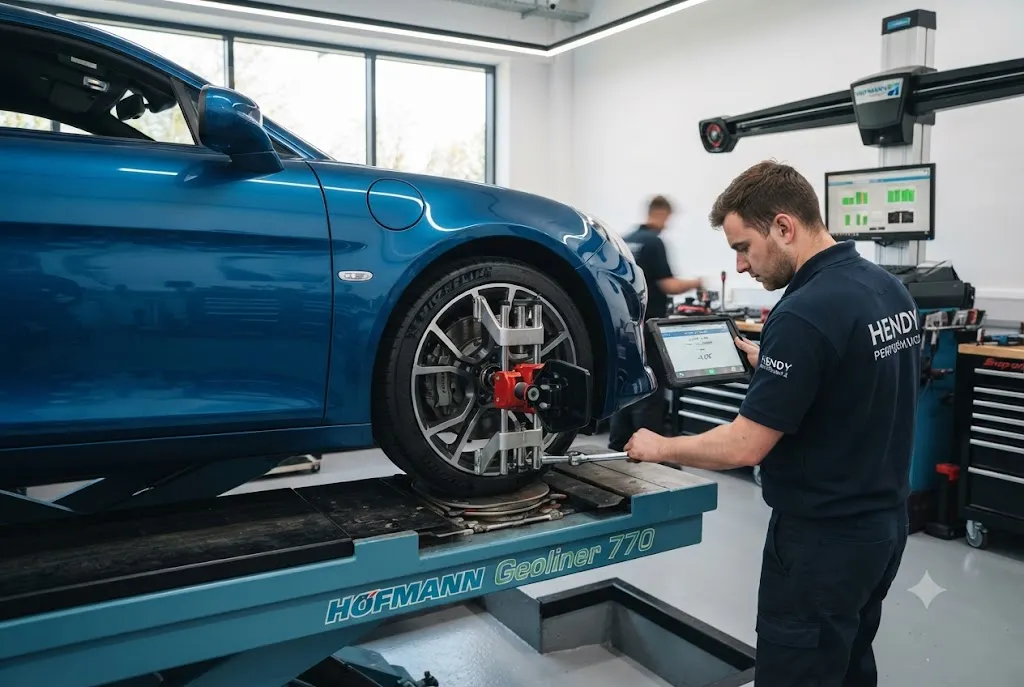
Wheel alignment is an important part of vehicle maintenance because incorrect alignment can affect steering behaviour, tyre wear and how confidently a car tracks along the road. If your vehicle pulls to one side, the steering wheel appears off-centre or one tyre is wearing faster than another, an alignment check may be worthwhile.
In the UK, motorists can choose between general garages, national tyre chains and specialist wheel alignment centres. The best option depends on the symptoms, the vehicle and whether the alignment problem is caused by a simple adjustment or an underlying suspension or steering fault.
This guide explains what wheel alignment means, how it differs from wheel balancing, what wheel tracking involves, when you may need it and what to consider when comparing alignment costs.
What Is Wheel Alignment?
Wheel alignment is the process of checking and, where possible, adjusting the angles of a vehicle’s wheels so they meet the manufacturer’s specifications. These angles influence how the tyres contact the road and how the vehicle behaves when driven.
Alignment is not simply about making all four wheels point in exactly the same direction. Modern vehicles are designed with specific geometry, and the correct settings depend on the suspension design and manufacturer requirements.
A professional alignment service normally uses specialised measuring equipment to identify whether the vehicle’s current geometry differs from the recommended settings.
If an adjustment is possible, the technician can make the appropriate changes. However, alignment equipment may also reveal worn or damaged components that need to be repaired before accurate alignment can be achieved.
Wheel Alignment vs Wheel Tracking
The terms wheel alignment and wheel tracking are often used interchangeably by garages, but motorists should still ask what the quoted service actually includes.
Historically, “tracking” has often been used to describe adjustment of the front wheels, particularly the toe angle. Modern four-wheel alignment services can measure a wider range of geometry and compare the vehicle against manufacturer specifications.
Because terminology varies between garages, ask whether the service involves a basic tracking adjustment or a comprehensive alignment measurement. This is particularly important if you have noticed uneven tyre wear or steering problems.
Signs You May Need Wheel Alignment
Alignment problems do not always produce an obvious warning. However, several symptoms can justify having the vehicle inspected.
The Car Pulls to One Side
If your car consistently moves towards the left or right when you are driving on a suitable, reasonably level road, alignment may be one possible cause.
However, pulling can also be associated with tyre pressures, tyre condition, braking problems or suspension faults. GOV.UK guidance notes that vehicle defects and incorrect tyre inflation can affect steering, while uneven tyre wear can be associated with braking or suspension faults or wheels being out of alignment.
The Steering Wheel Is Off-Centre
If the vehicle travels relatively straight but the steering wheel sits noticeably to one side, the steering and wheel geometry should be checked.
An off-centre steering wheel does not automatically prove that alignment is the cause. A professional inspection is useful because steering and suspension components can also influence the symptom.
Uneven Tyre Wear
Uneven tyre wear is one of the most useful clues that something may be wrong with the vehicle’s wheels, suspension or alignment.
Look at the inside and outside edges of the tyres rather than only inspecting the centre tread. If one edge is wearing significantly faster than the other, arrange an inspection.
The official Highway Code specifically advises motorists that excessive or uneven tyre wear can be caused by braking or suspension faults or wheels being out of alignment, and recommends having such faults corrected promptly.
The Car Feels Unstable
If the steering feels unusually vague, the vehicle wanders or the car does not seem to maintain its direction as expected, do not automatically assume that alignment is the only issue.
Tyres, steering components, suspension and wheel condition should all be considered. A proper inspection can determine whether an alignment service is appropriate.
What Causes Wheel Alignment Problems?
Wheel geometry can change for several reasons. One common cause is impact damage from potholes, kerbs or other road hazards.
A significant impact can affect suspension or steering components and potentially change wheel geometry. In some cases, the alignment can be corrected with adjustment. In others, a damaged component needs replacing first.
Normal wear can also contribute. Suspension bushes, steering components and other parts can deteriorate over time, which can affect the geometry of the vehicle.
Changing suspension components can also alter alignment settings. For this reason, an alignment check may be sensible after certain suspension repairs or modifications.
Why Uneven Tyre Wear Should Not Be Ignored
Uneven tyre wear can reduce the useful life of a tyre and may indicate that another vehicle component needs attention.
Replacing the tyre without investigating the underlying cause can result in the replacement wearing unevenly again. That can turn what initially appears to be a tyre problem into a repeated maintenance expense.
GOV.UK states that motorists are responsible for keeping their vehicles roadworthy and notes that tyres must have the correct tread depth and be free from cuts and defects.
For passenger cars, the current MOT inspection guidance also requires tyres to meet applicable tread-depth and condition requirements.
Wheel Alignment and Wheel Balancing Are Different
Wheel alignment and wheel balancing are separate services, even though garages may recommend both during a tyre or suspension inspection.
The Wheel alignment concerns the geometry and positioning of the wheels relative to the vehicle and manufacturer specifications.
Wheel balancing concerns the distribution of weight around a wheel and tyre assembly. An imbalance can contribute to vibration, particularly at certain speeds.
If you experience steering-wheel vibration, ask the garage to investigate balancing as well as other possible causes. If you experience uneven tyre wear or the vehicle pulls to one side, alignment and suspension checks may be more relevant.
What Happens During a Wheel Alignment Service?
A proper alignment service should begin with an assessment of the vehicle rather than immediately adjusting settings.
The technician may first inspect the tyres, wheels, steering and suspension for obvious problems. Tyre pressures and other relevant conditions should also be considered because they can influence the vehicle’s behaviour.
The vehicle is then positioned on alignment equipment that measures wheel geometry. Depending on the equipment and vehicle, the system can identify measurements such as toe, camber and caster.
Toe
Toe describes the direction the wheels point relative to the vehicle’s centreline when viewed from above. Incorrect toe settings can contribute to tyre wear and handling problems.
Camber
Camber describes the inward or outward tilt of the wheel when viewed from the front. The correct value depends on the vehicle’s suspension design and manufacturer specifications.
Caster
Caster relates to the steering axis when viewed from the side of the vehicle. It can influence steering feel, stability and the way the steering returns towards centre.
Not every alignment problem can be corrected through adjustment alone. If the measured geometry is outside the permitted range because a component is bent or worn, repair may be necessary before alignment can be completed properly.
How Much Does Wheel Alignment Cost in the UK?
There is no single UK-wide alignment cost. Prices vary according to the garage, vehicle, location, type of alignment equipment and whether the service covers two or four wheels.
A basic front-wheel tracking adjustment will generally be a different service from a comprehensive four-wheel alignment with detailed measurements and adjustments.
When comparing prices, ask:
- Is the quotation for front tracking or four-wheel alignment?
- Is a before-and-after measurement report included?
- Are adjustments included in the advertised price?
- Will the garage inspect steering and suspension components first?
- Will you be contacted if repairs are required?
- Is VAT included?
Comparing like-for-like services is important. The cheapest advertised price may only cover a basic adjustment rather than a complete alignment inspection.
When Should You Book Specialist Wheel Alignment?
A specialist wheel alignment service can be useful when the vehicle has persistent handling or tyre-wear problems, has modified suspension or requires more detailed geometry measurements.
Specialist alignment centres may have advanced equipment and technicians who perform alignment work regularly. This can be particularly useful for vehicles with complex suspension systems or unusual alignment requirements.
However, specialist equipment does not replace basic mechanical inspection. If a suspension component is worn, even the most advanced alignment machine cannot make the underlying problem disappear.
Should You Get Alignment After Hitting a Pothole?
A pothole impact does not automatically mean that your vehicle needs alignment, but a significant impact can justify an inspection, particularly if the vehicle’s behaviour changes afterwards.
Look for symptoms such as:
- New steering-wheel vibration
- The vehicle pulling to one side
- A steering wheel that is no longer centred
- New or uneven tyre wear
- Unusual suspension noises
- Visible wheel or tyre damage
If you notice damage or significant changes in handling after an impact, have the vehicle inspected promptly rather than continuing to drive while assuming that the issue is minor.
Wheel Alignment After New Tyres
Fitting new tyres does not automatically mean that an alignment is required. However, new tyres can make an existing alignment problem more noticeable because their tread is fresh and unworn.
If your old tyres show uneven wear, it is sensible to investigate why before fitting replacement tyres. Otherwise, the new set could develop the same pattern.
Some drivers also choose an alignment check when replacing tyres as preventative maintenance, particularly if the vehicle has experienced pothole or kerb impacts.
How to Choose a Wheel Alignment Service
When comparing garages, consider more than the advertised price.
Check the Equipment
Ask whether the garage uses four-wheel alignment equipment and whether the system is suitable for your vehicle. A professional centre should be able to explain what the measurement covers.
Ask for Before-and-After Measurements
A measurement report can show what was found and whether the settings changed after adjustment. This can make the service easier to understand and provides useful maintenance documentation.
Check Reviews
Look for recent customer reviews relating specifically to wheel alignment, steering problems or tyre wear. A garage that performs a large amount of tyre work is not necessarily a specialist alignment centre.
Ask About Suspension Inspection
If the garage discovers excessive play or damaged components, alignment may need to wait until those issues are repaired. Ask whether an initial inspection is included.
Wheel Alignment for Hybrid and Electric Vehicles
Wheel alignment is relevant to hybrid and electric vehicles as well as conventional cars. Their steering, suspension and tyres still need to maintain the correct geometry.
EV owners may want to pay particular attention to tyre condition because electric vehicles can have substantial vehicle weights and strong instant torque. However, alignment requirements remain vehicle-specific and should follow manufacturer specifications.
If you own an EV, our guide to EV servicing covers wider maintenance considerations, including tyres, brakes, suspension and specialist diagnostics.
Hybrid owners can also use our hybrid servicing guide to understand how conventional maintenance and hybrid-system expertise fit together.
Wheel Alignment and Garage Choice
National tyre and garage chains can be convenient because they often have dedicated tyre and alignment services. Independent workshops can also provide excellent alignment work, particularly when they have experienced technicians and appropriate equipment.
When choosing between them, compare the exact branch rather than relying solely on the brand name. Ask what alignment equipment is used, what is included in the service and whether the garage can investigate suspension problems if the measurements reveal an underlying fault.
Our garage comparison guide explains how to assess garages based on service quality, customer feedback, pricing and technical capability.
Can Wheel Alignment Improve Tyre Life?
Correct wheel geometry can help tyres wear more evenly when alignment is one of the causes of abnormal wear. However, tyre life also depends on inflation pressure, driving style, road conditions, suspension condition, tyre design and many other factors.
Therefore, alignment should not be presented as a guarantee of longer tyre life. It is one part of maintaining the vehicle’s wheels, tyres, steering and suspension correctly.
Regularly checking tyre condition remains important. GOV.UK recommends checking tyre pressures weekly when tyres are cold and stresses that incorrect inflation can adversely affect braking and steering.
Wheel Alignment and MOTs
A wheel alignment service is not the same as an MOT. The MOT checks specific roadworthiness requirements, including areas relating to wheels, tyres and suspension, but a passed MOT does not mean that your vehicle has perfect alignment.
The current MOT inspection manual contains detailed requirements for wheels, tyres, suspension and related components.
If your car passes its MOT but subsequently develops uneven tyre wear or steering symptoms, you can still arrange an alignment inspection.
Questions to Ask Before Booking
A few questions can help you understand exactly what you are paying for:
- Do you provide four-wheel alignment?
- Is the service different from basic wheel tracking?
- Will you inspect the steering and suspension first?
- Are adjustments included in the quoted price?
- Can I receive the alignment measurements?
- What happens if a component is worn?
- Can you work to the manufacturer’s alignment specifications?
- Will you tell me before carrying out additional repairs?
A garage that provides clear answers is easier to compare with other providers and can help prevent misunderstandings about the service.
Final Thoughts on Wheel Alignment
Wheel alignment is worth considering when a vehicle develops uneven tyre wear, steering symptoms or handling changes, particularly after a significant pothole or kerb impact. However, alignment should be treated as part of a wider inspection rather than a guaranteed solution to every steering or tyre problem.
When comparing alignment services, find out whether you are being quoted for basic tracking or a comprehensive four-wheel measurement and adjustment. Check the garage’s equipment, reviews, diagnostic approach and ability to identify worn suspension or steering components.
Most importantly, do not ignore unusual tyre wear or steering behaviour. Correct tyre pressures, healthy suspension, properly maintained steering components and appropriate wheel geometry all contribute to safe and predictable vehicle handling.
Choosing a reputable garage and dealing with alignment problems early can help you avoid unnecessary tyre wear and identify mechanical issues before they become more serious.
