

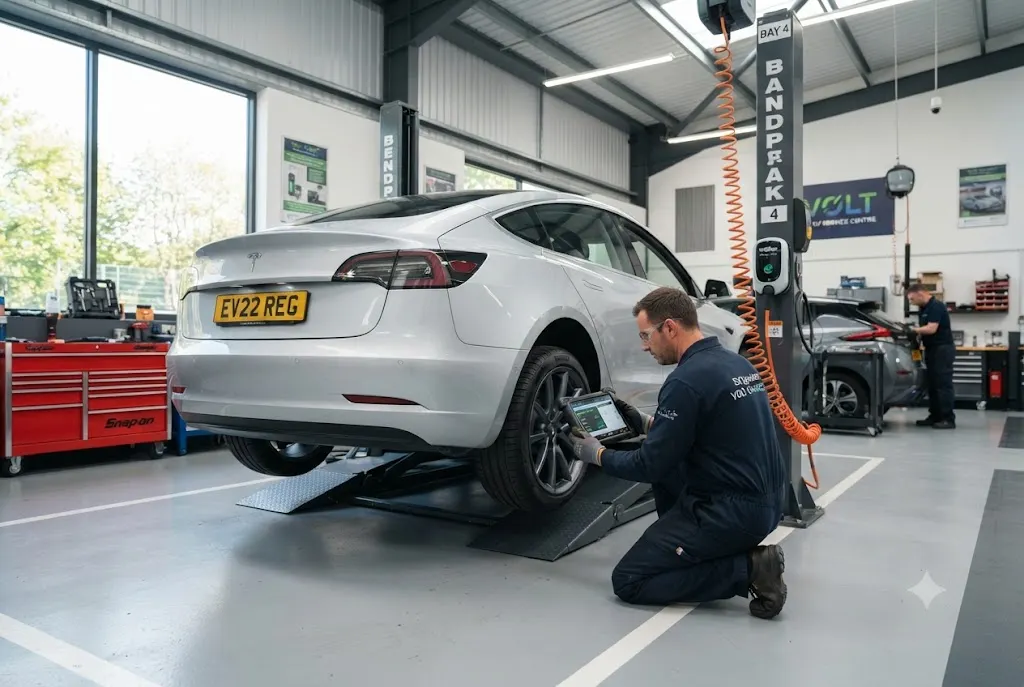
Choosing the right EV servicing centre is increasingly important for UK drivers as electric vehicles become a larger part of the car market. Although EVs have fewer conventional drivetrain components than petrol or diesel cars, they still require professional maintenance. Brakes, tyres, suspension, steering, cooling systems, charging equipment and electronic systems all need appropriate attention.
Electric vehicles also contain high-voltage batteries and electrical components that require specialist knowledge when diagnosis, repair or replacement is involved. For that reason, an ordinary garage may be suitable for some routine work, while a trained EV specialist can be a better choice for high-voltage diagnostics and more complex repairs.
This guide explains what to look for in an EV garage, what electric vehicle maintenance can involve and how to compare independent specialists, national garage chains and authorised service centres.
What Is EV Servicing?
EV servicing involves inspecting and maintaining an electric vehicle’s mechanical, electrical and electronic systems. Unlike a conventional car, a fully electric vehicle does not have a petrol or diesel engine requiring engine oil changes, spark plugs or many of the other engine-related maintenance tasks associated with combustion vehicles.
However, that does not mean an EV is maintenance-free. Electric vehicles still use tyres, brakes, suspension components, steering systems, windscreen washers, cabin filters and other equipment that can require inspection or replacement.
The vehicle’s battery, electric motor, inverter, charging system and associated electronics also require specialist attention when faults occur.
The exact maintenance schedule depends on the manufacturer and model, so owners should use the vehicle handbook and manufacturer’s recommended service information as the starting point.
Why Specialist EV Servicing Matters
One of the biggest differences between electric vehicles and conventional cars is the presence of high-voltage systems. These components can present serious hazards if handled incorrectly.
The Institute of the Motor Industry (IMI) has specific qualifications for technicians working with electric and hybrid vehicles. Its Level 2 qualification covers safe routine maintenance around high-voltage systems, including understanding hazards and safely isolating and reinstating systems. However, the qualification itself does not certify a technician to work directly on the vehicle’s high-voltage system.
More advanced IMI qualifications cover diagnosis, testing, repair and replacement of high-voltage vehicle systems and components.
This distinction matters when choosing an EV mechanic. A garage may be able to perform routine maintenance on an electric car without being equipped to repair a damaged high-voltage battery or electrical component.
What Does EV Servicing Include?
The precise service checklist varies between manufacturers, but several areas are commonly relevant to electric vehicle maintenance.
Brakes
EVs use regenerative braking to recover energy and return some of it to the battery. This can alter how frequently the conventional friction brakes are used, but it does not eliminate the need to inspect them.
Brake discs, pads, callipers and other braking components can still deteriorate. A professional service should assess their condition and identify anything that requires attention.
Brake maintenance remains important for road safety. The UK Highway Code advises motorists to pay particular attention to brakes, steering and tyres and states that vehicles must be maintained in a safe condition.
Tyres
Tyres are particularly important on electric vehicles because EVs can have substantial kerb weights and deliver strong instant torque. Correct tyre pressure, tread condition and general tyre health should therefore form part of routine vehicle checks.
Uneven tyre wear can also point to wheel alignment, suspension or other problems. If your EV pulls to one side or wears tyres unevenly, ask the garage to investigate the cause rather than simply replacing the affected tyre.
Suspension and Steering
Electric vehicles still rely on conventional suspension and steering components. Bushes, shock absorbers, ball joints and other components can wear with age and mileage.
Suspension problems can also affect tyre wear and handling. The UK Highway Code specifically notes that excessive or uneven tyre wear can be associated with braking or suspension faults and wheels being out of alignment.
For more information about alignment problems, see our guide to wheel alignment.
Cooling Systems
Many EVs use thermal-management systems to control the temperature of the battery, motor and other components. Depending on the vehicle, these systems can involve coolant, pumps, valves, radiators and other components.
Maintenance requirements vary considerably between models, so the workshop should follow the manufacturer’s procedure rather than applying a generic checklist.
Charging System
The charging system is another important part of electric vehicle maintenance. Faults can occur in charging hardware, connectors, cables, onboard charging equipment or related electronic systems.
If an EV repeatedly fails to charge, charges more slowly than expected or displays charging-related warnings, the problem should be diagnosed rather than assumed to be a battery fault.
EV Battery Servicing Explained
The traction battery is usually one of the most expensive components in an electric vehicle, which understandably makes battery health a major concern for owners.
However, EV battery servicing does not simply mean opening the battery pack and replacing individual cells. The appropriate diagnostic process depends on the manufacturer, battery design and nature of the problem.
A qualified EV specialist may be able to assess battery-related fault codes, system performance, thermal management and other relevant information. More advanced battery diagnosis or repair requires technicians with appropriate high-voltage training and equipment.
The IMI maintains dedicated EV training pathways, including qualifications addressing high-voltage battery diagnosis and the condition of electric vehicle high-voltage batteries.
If a garage recommends replacing an entire battery pack, ask what diagnostics were performed and whether the manufacturer has a repair or replacement procedure for the identified fault.
Do Electric Cars Need Regular Servicing?
Yes. The absence of a conventional combustion engine does not mean an EV can be ignored between MOT tests.
The manufacturer’s service schedule remains the most reliable source for model-specific maintenance requirements. Some vehicles may have annual inspections, while others can use mileage- or time-based schedules that differ according to the model.
Owners should also remember that an MOT and a service are not the same thing. The MOT assesses whether a vehicle meets specified roadworthiness requirements at the time of the test. A service is a broader maintenance process determined by the vehicle manufacturer and its condition.
The Driver and Vehicle Standards Agency’s current MOT inspection manual includes inspection requirements for areas such as brakes, wheels, tyres and suspension.
EV Mechanics: What Training Should You Look For?
When searching for EV mechanics, ask specifically about electric vehicle training rather than assuming that general automotive qualifications cover every high-voltage task.
Useful questions include:
- Do your technicians have recognised EV training?
- Can you work safely around high-voltage systems?
- Do you provide EV diagnostics?
- Can you service my specific make and model?
- Do you diagnose charging faults?
- Can you assess battery-related fault codes?
- Are technicians qualified for the type of high-voltage repair required?
- What warranty applies to parts and labour?
The level of expertise should match the job. Routine maintenance and direct high-voltage system repair are not necessarily the same skill level.
EV Garages: Independent vs National Chains
EV owners can choose from independent specialists, national garage chains and manufacturer-authorised service centres.
An independent EV garage may offer specialist knowledge and competitive labour rates. Some independents focus specifically on electric and hybrid vehicles, making them useful for owners who want a workshop with substantial experience in the technology.
National garage chains can provide convenience, multiple locations and established booking systems. However, EV capability may vary between branches, so confirm that the exact location can perform the work you require.
Manufacturer-authorised service centres can be attractive for newer vehicles, complex faults and manufacturer-specific diagnostics. They may also have direct access to brand-specific technical information and repair procedures.
Our garage comparison guide explains how to assess independent garages, franchise businesses and authorised service centres using factors such as customer reviews, service quality and pricing.
EV Servicing at Garage Chains
Large UK automotive networks are increasingly relevant to EV owners because many have expanded their capabilities beyond traditional fast-fit work.
However, the presence of EV servicing on a company’s website does not necessarily mean every branch offers every EV-related repair. Always check the exact service centre before making an appointment.
You can also review our guide to garage chains for a broader look at major UK automotive networks and the factors motorists should consider when comparing branches.
Charging System Maintenance
Charging problems can be frustrating because they may involve the vehicle, charging cable, home charger, public charging equipment or electrical supply rather than the battery itself.
If your EV cannot charge, begin by recording exactly what happens. Note any dashboard warning, charging error message, unusual indicator behaviour or change in charging speed.
A competent EV workshop can then investigate whether the issue originates in the vehicle’s charging hardware or another part of the system.
Do not attempt to dismantle or repair high-voltage charging components yourself. Work involving high-voltage vehicle systems should be handled by appropriately trained professionals.
Signs Your EV Needs Attention
Electric vehicles can provide useful warning messages when a system develops a fault. Owners should not ignore persistent warnings simply because the vehicle continues to drive.
Arrange an inspection if you notice:
- Persistent EV system warning lights
- Repeated charging failures
- Unexpected changes in charging behaviour
- Reduced driving performance
- Unusual battery or electrical-system warnings
- Unusual noises from the drivetrain
- Brake performance changes
- Uneven tyre wear or steering problems
- Cooling-system warnings
These symptoms can have multiple causes. A warning message should therefore be treated as a reason for diagnosis rather than proof that a particular component has failed.
How Much Does EV Servicing Cost?
There is no single UK price for EV servicing. Costs vary according to the vehicle, manufacturer, service schedule, location, garage type and work required.
Some routine EV maintenance can be relatively straightforward because electric cars have fewer conventional drivetrain components. However, specialist diagnostics, charging faults, battery problems and high-voltage repairs can require additional equipment and technician expertise.
When comparing quotations, make sure you are comparing the same work. Ask whether diagnostic checks, inspections, replacement parts, labour and VAT are included.
If a garage identifies additional work, ask for a written or itemised quotation before authorising repairs wherever practical.
How to Choose the Best EV Service Centre
The best EV service centre should be appropriate for both your car and the specific work required. Consider these factors before booking.
EV-Specific Training
Look for evidence that technicians have completed appropriate electric or hybrid vehicle training. IMI provides recognised pathways for routine maintenance and more advanced high-voltage system work.
Diagnostic Capability
A garage should have suitable diagnostic equipment for your vehicle. Generic diagnostic tools may not provide everything needed to investigate a manufacturer-specific EV fault.
Battery Expertise
If your concern involves battery health, ask whether the garage performs battery diagnostics and what testing is included. Be cautious of any business that immediately recommends expensive battery replacement without explaining the diagnostic evidence.
Charging Knowledge
For charging-related faults, choose a garage that understands onboard charging systems and EV electrical architecture. Make sure you explain whether the problem occurs at home, at public chargers or in both situations.
Customer Reviews
Recent customer reviews can help reveal how a garage handles communication, diagnosis, pricing and repair quality. Look for feedback specifically relating to EV work when available.
Warranty and Documentation
Ask what warranty applies to replacement parts and labour. Keep invoices and service records as part of the vehicle’s maintenance history.
EV Servicing and Tyre Maintenance
Tyres deserve particular attention during EV ownership. Electric vehicles can place different demands on tyres because of their weight and drivetrain characteristics.
Check tyre pressures regularly and inspect the tread and sidewalls for damage. If the vehicle develops uneven wear, do not assume that replacing the tyres will solve the problem.
A wheel alignment check may be appropriate if steering behaviour or tyre wear suggests an alignment issue. The UK Highway Code advises that faults associated with uneven tyre wear, braking, suspension or wheel alignment should be corrected promptly.
EV Servicing and Brake Maintenance
Regenerative braking can reduce reliance on conventional friction braking during some driving conditions, but brake components still need inspection.
Drivers should pay attention to changes in brake feel, unusual noises, warning lights or other signs of deterioration. A service centre should inspect the braking system according to the vehicle’s maintenance requirements rather than assuming that regenerative braking eliminates conventional brake maintenance.
For safety-related maintenance, the UK’s official guidance states that motorists are responsible for ensuring their vehicle remains safe to drive even when it has a current MOT certificate.
Can Any Garage Service an Electric Vehicle?
Not every garage has the same level of EV capability. Some workshops may be comfortable with tyres, brakes, suspension and other conventional maintenance, while others have technicians qualified to diagnose and repair high-voltage systems.
The difference becomes particularly important when a repair involves the traction battery, inverter, high-voltage cabling or other high-energy components.
IMI’s EV accreditation framework is specifically aimed at technicians involved in the inspection, maintenance and repair of electric vehicles and high-voltage components.
Therefore, ask the workshop what it is trained and equipped to do before booking complex work.
EV Maintenance for Long-Term Ownership
Good EV ownership is not about eliminating maintenance. It is about understanding which components need attention and following the manufacturer’s maintenance recommendations.
Keep service records, monitor tyre condition, pay attention to warning messages and investigate charging problems early. Regular checks can also help identify mechanical issues that have nothing to do with the battery.
It is useful to separate normal maintenance from specialist repairs. A tyre replacement or routine inspection does not necessarily require the same specialist expertise as a high-voltage battery diagnosis.
That distinction can help owners choose the right garage without paying specialist rates for work that does not require advanced EV expertise.
Final Thoughts on EV Servicing
The best EV servicing option depends on the vehicle, the work required and the workshop’s level of electric vehicle expertise. Independent EV specialists can provide focused knowledge, national garage networks can offer convenience, and authorised service centres can be valuable for manufacturer-specific diagnostics and complex repairs.
When comparing EV garages, look beyond price. Check technician training, diagnostic equipment, battery expertise, charging-system capability, customer reviews, warranties and the exact services offered by the branch.
Most importantly, do not treat an electric vehicle as maintenance-free. Although EVs have fewer conventional drivetrain components, tyres, brakes, suspension, steering, cooling systems, charging equipment and high-voltage components still require appropriate care.
Choosing a suitably trained workshop and following the manufacturer’s maintenance schedule can help keep an electric vehicle safe, reliable and efficient throughout its ownership.
