

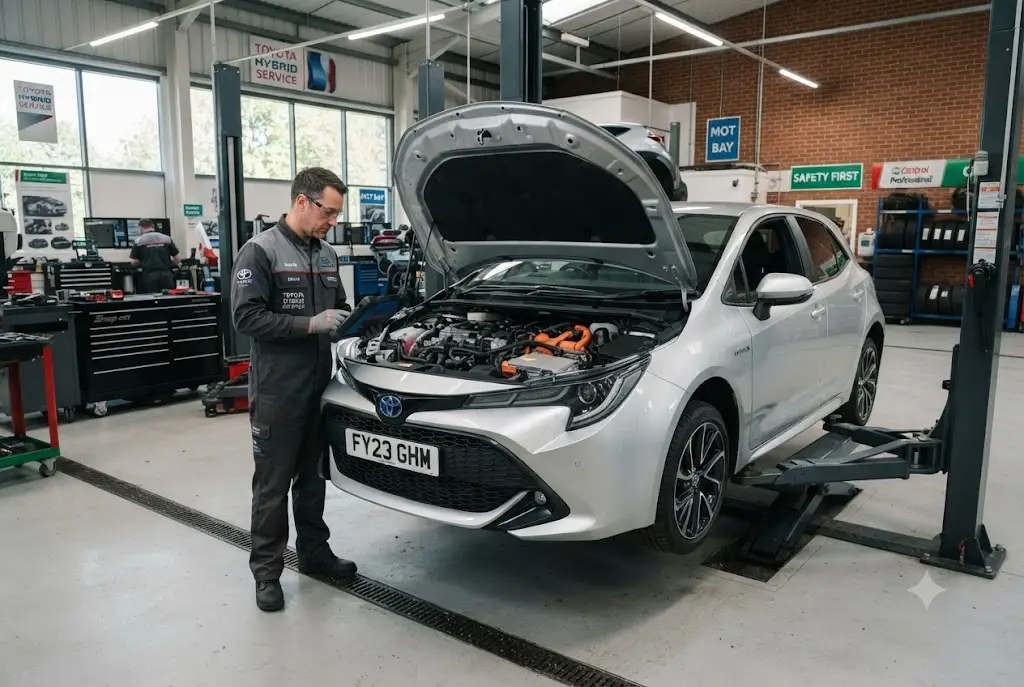
Choosing the right hybrid servicing centre is important because hybrid vehicles combine conventional mechanical components with high-voltage electrical systems. Routine maintenance still includes familiar items such as tyres, brakes, fluids and suspension, but some inspections and repairs require technicians with appropriate hybrid training, diagnostic equipment and safety procedures.
For UK hybrid owners, the best workshop is not necessarily the largest garage or the cheapest option. Instead, look for a service centre that understands your particular hybrid system, can carry out the required maintenance safely and clearly explains any work identified during an inspection.
This guide explains what to look for when choosing a hybrid specialist, what hybrid maintenance can involve and when manufacturer or specialist expertise may be worthwhile.
What Is Hybrid Servicing?
Hybrid servicing is the inspection and maintenance of a vehicle that combines an internal combustion engine with an electric motor and high-voltage electrical components. The exact system varies between manufacturers, so servicing requirements depend on the vehicle’s make, model, age, mileage and hybrid technology.
Some routine maintenance is similar to that of a conventional petrol or diesel car. A workshop may inspect the brakes, tyres, suspension, steering, fluids, filters and other mechanical components. However, hybrid vehicles also contain components that require additional technical knowledge.
These can include the hybrid battery, inverter, electric motor, battery cooling system and associated electrical controls. A competent hybrid workshop should understand how these systems interact rather than treating the vehicle as an ordinary petrol car.
Why Specialist Hybrid Servicing Matters
Hybrid vehicles are designed to operate safely and efficiently, but their high-voltage systems require appropriate procedures when technicians carry out certain types of work.
The Institute of the Motor Industry (IMI) provides dedicated electric and hybrid vehicle qualifications covering areas such as high-voltage safety, system isolation, diagnostics, testing and repair. Its Level 3 qualification, for example, covers safe work on high-voltage systems and the repair or replacement of high-voltage components.
This does not mean every routine service requires advanced high-voltage repair expertise. However, it demonstrates why motorists should ask whether a garage has appropriate training when the required work involves the hybrid electrical system.
For routine maintenance, an appropriately trained technician may be sufficient. More complex diagnostics or high-voltage repairs can require a higher level of specialist competence and equipment.
What Does Hybrid Servicing Include?
The exact service schedule differs between manufacturers, but a hybrid service can include many of the same checks performed on conventional vehicles.
Engine and Fluid Checks
Where a hybrid uses a petrol engine, the engine still requires appropriate maintenance. Depending on the manufacturer’s schedule, this can involve engine oil, filters, coolant and other fluids.
Although the electric motor can reduce the amount of time the combustion engine operates, it does not eliminate the need for conventional engine maintenance.
Brake Inspection
Hybrid vehicles often use regenerative braking, which allows the electric motor to recover energy during deceleration. This can change how frequently some friction-braking components are used, but brake inspections remain important.
A service centre should still assess brake discs, pads, calipers and other relevant components according to the vehicle’s condition and manufacturer requirements.
Tyres and Suspension
Tyres, steering and suspension remain essential safety components. A hybrid’s additional battery weight and different driving characteristics make it just as important to monitor tyre condition, pressures, suspension components and alignment.
If your vehicle has uneven tyre wear or steering symptoms, our guide to wheel alignment explains what motorists should know about alignment checks and related wheel problems.
Hybrid System Diagnostics
Hybrid systems rely on electronic control units and sensors to coordinate the combustion engine, electric motor, battery and other components. Diagnostic equipment can therefore be important when warning lights appear or the vehicle develops unusual behaviour.
A suitable workshop should be able to identify whether a fault is mechanical, electrical or related to the hybrid control system before recommending repairs.
Hybrid Battery Servicing Explained
The hybrid battery is one of the components that most often causes concern among owners, particularly as vehicles become older.
Hybrid battery servicing does not necessarily mean dismantling or repairing the battery pack. Depending on the vehicle and the manufacturer’s procedures, a workshop may inspect battery-related systems, check diagnostic information, assess cooling arrangements or investigate warning messages.
The appropriate process depends heavily on the vehicle. A workshop should therefore avoid making broad promises about battery condition based on a quick inspection alone.
If a battery fault is suspected, ask the garage what testing has been performed and whether the recommendation involves further diagnostic work, component replacement or manufacturer support.
How Often Does a Hybrid Need Servicing?
There is no single service interval that applies to every hybrid vehicle. Owners should follow the manufacturer’s maintenance schedule for their particular model.
For example, Toyota UK states that its hybrid vehicles should generally be serviced every 12 months or 10,000 miles, whichever comes first, although specific warranty and service terms apply.
Other manufacturers can use different intervals. Therefore, your handbook, manufacturer service schedule or official servicing information should be the starting point.
Keeping up with scheduled maintenance can also make it easier to identify developing mechanical or electrical problems before they become more expensive repairs.
How to Find Hybrid Specialists in the UK
When searching for hybrid specialists, start by looking for garages that explicitly advertise hybrid servicing rather than assuming that every modern workshop has the same capabilities.
Then investigate the individual garage. Useful questions include:
- Do your technicians have recognised hybrid or EV training?
- Can you service my exact make and model?
- Do you have suitable hybrid diagnostic equipment?
- Can you carry out hybrid battery diagnostics?
- Do you handle high-voltage system repairs?
- What service schedule do you follow?
- What warranty applies to parts and labour?
The answers can help you distinguish a garage that routinely works with hybrids from one that simply accepts hybrid vehicles for basic mechanical work.
Manufacturer Dealer or Independent Hybrid Garage?
Hybrid owners often have to decide between a manufacturer dealer and an independent specialist.
A manufacturer dealer may be attractive when the vehicle is relatively new, requires manufacturer-specific diagnostics or is covered by a relevant service or warranty programme. Dealers may also have direct access to brand-specific technical information and equipment.
An independent hybrid specialist can be attractive when the vehicle is older or outside its manufacturer warranty. A reputable specialist may offer competitive pricing while still having the training and equipment required for hybrid work.
There is no universal answer. Compare the garage’s expertise, price, reviews, warranty and ability to work on your specific model.
Hybrid Servicing at National Garage Chains
Some large UK garage chains have expanded their services to include hybrid and electric vehicles. This can be convenient for motorists who prefer a familiar brand with multiple branches.
However, hybrid capability can vary between branches. Before booking, confirm that the exact centre you intend to use offers the required hybrid service and has technicians appropriately trained for the work.
Our garage chains guide covers major UK automotive service networks and explains why motorists should compare individual branches rather than relying solely on a national brand name.
You can also use our garage comparison guide to assess independent garages, franchise networks and authorised service centres based on factors such as service quality, reviews and pricing.
Hybrid Maintenance That Owners Should Not Ignore
Hybrid ownership does not remove the need for normal vehicle maintenance. In fact, some routine checks become particularly important because a fault in one part of the vehicle can affect the wider system.
Keep an eye on warning lights, unusual noises, changes in fuel economy, brake behaviour, engine operation and the vehicle’s overall performance.
Tyre pressures should also be checked regularly. Uneven tyre wear can indicate alignment, suspension or tyre-related issues. Early investigation can help prevent a relatively simple problem from developing into a more expensive repair.
What About Hybrid Battery Health?
Battery health is one of the most important considerations for owners of older hybrid cars. However, motorists should avoid assuming that reduced fuel economy automatically means the battery is failing.
Hybrid performance depends on several systems working together. Engine condition, tyre pressures, driving conditions, temperature, brakes and other components can all influence efficiency.
If you notice a significant change in how the hybrid system operates, ask for proper diagnostics rather than immediately authorising battery replacement.
A qualified technician can investigate the vehicle’s diagnostic information and determine whether the problem is actually related to the battery or another component.
Signs Your Hybrid May Need Attention
Some warning signs should prompt an inspection rather than being ignored. These can include:
- Hybrid system warning lights
- Unusual engine or motor behaviour
- Unexpected changes in fuel economy
- Reduced or inconsistent electric assistance
- Unusual braking behaviour
- Cooling fan noise that seems abnormal
- Difficulty starting or operating the vehicle
- Unusual warning messages on the dashboard
The presence of one of these symptoms does not automatically identify a particular fault. A proper diagnosis is needed before deciding what repair is necessary.
Can Any Garage Work on a Hybrid?
Some routine mechanical tasks on a hybrid vehicle can be carried out by general automotive workshops, provided the garage has the appropriate knowledge and equipment for the job.
However, that should not be confused with permission or competence to work directly on high-voltage components. IMI qualifications distinguish routine maintenance knowledge from the higher-level skills required for high-voltage system repair and replacement.
For this reason, ask the garage exactly what work it is qualified and equipped to perform. If the repair involves the high-voltage system, choose a workshop with specific hybrid or EV qualifications and suitable safety procedures.
How Much Does Hybrid Servicing Cost?
There is no reliable single price for hybrid servicing across the UK. Costs vary according to the vehicle, manufacturer, service level, location, parts, labour and any additional repairs discovered during inspection.
Routine servicing may be comparable to conventional vehicle maintenance in some respects, while specialist diagnostics or hybrid-system repairs can cost more because they require additional equipment and technical expertise.
Rather than choosing the lowest headline price, request an itemised quotation. Ask what is included, whether diagnostic checks are part of the service and whether additional work requires your approval.
How to Choose the Best Hybrid Service Centre
A good hybrid service centre should be able to demonstrate that it understands the technology in your vehicle. Before booking, consider these factors:
Relevant Training
Ask whether technicians have recognised hybrid or electric vehicle training. Specialist training is particularly important for work involving high-voltage systems.
Diagnostic Equipment
Hybrid systems can require specialist diagnostic tools. Confirm that the garage can diagnose your particular make and model rather than relying only on generic fault-code equipment.
Transparent Pricing
Request a clear quotation and establish how additional repairs will be approved. Transparency is more valuable than an artificially low starting price.
Recent Reviews
Look for recent customer feedback relating specifically to hybrid vehicles where possible. Reviews about ordinary servicing may not tell you whether a garage has handled complex hybrid diagnostics successfully.
Warranty and Documentation
Ask about parts and labour warranties and request an itemised invoice. Keep service records because they can help demonstrate how the vehicle has been maintained over time.
Hybrid Ownership and Long-Term Maintenance
Good hybrid ownership is largely about consistent maintenance rather than waiting for major problems to appear. Follow the manufacturer’s service schedule, respond to warning lights and use a suitably equipped workshop when specialist work is required.
It is also worth understanding your particular hybrid system. Different manufacturers use different approaches to battery management, regenerative braking and engine operation, so generic advice should not replace model-specific maintenance information.
As hybrid technology becomes more common, specialist knowledge is increasingly important. The IMI’s current training framework includes dedicated qualifications for routine maintenance as well as more advanced high-voltage diagnosis and repair.
Final Thoughts on Hybrid Servicing
The best hybrid servicing centre is one that matches the technology and maintenance requirements of your vehicle. A general garage may be perfectly suitable for some routine mechanical work, while hybrid specialists or manufacturer-authorised workshops can be preferable for advanced diagnostics and high-voltage repairs.
Before booking, check technician training, diagnostic capability, service coverage, customer reviews, pricing and warranty arrangements. Do not assume that every branch of a large garage chain has identical hybrid expertise.
Most importantly, treat hybrid maintenance as a combination of conventional vehicle care and specialist electrical-system knowledge. With the right workshop and a consistent maintenance schedule, owners can make informed decisions about servicing while avoiding unnecessary repairs and costs.
