

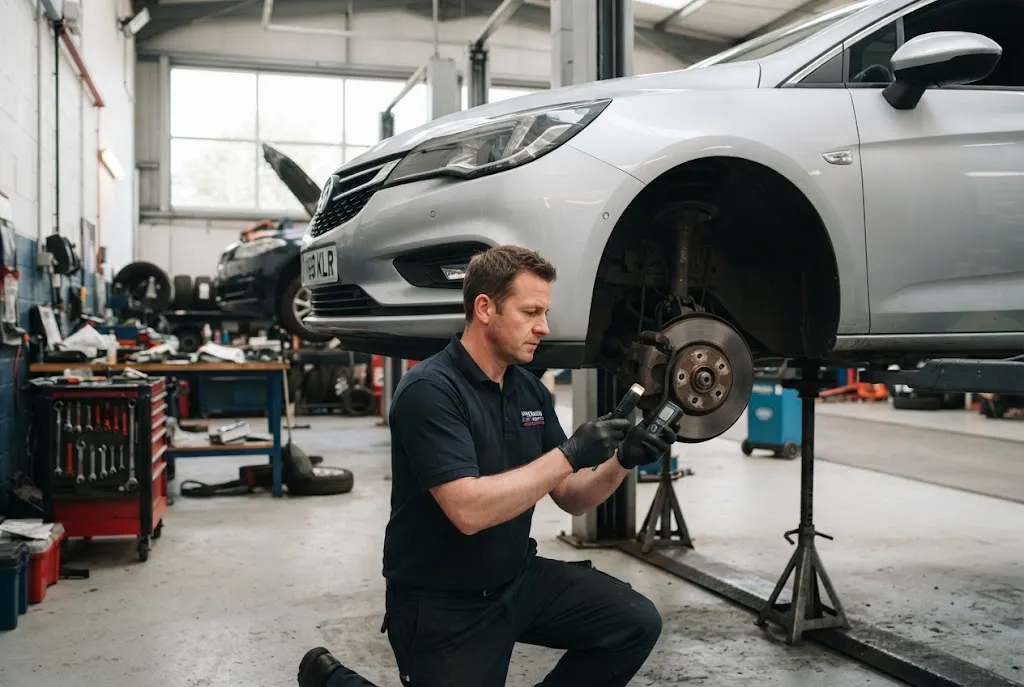
Brakes are safety-critical components, so unusual noises, changes in pedal feel, pulling while braking or warning lights should not be ignored. GOV.UK advises drivers to make sure their brakes work and remain responsible for keeping their vehicle roadworthy, even when it has a current MOT. GOV.UK vehicle safety guidance provides further information on basic roadworthiness checks.
What Do Brake Services Include?
Brake services cover a range of inspections, maintenance tasks and repairs designed to keep the braking system working correctly. The exact work depends on the vehicle, its condition, mileage, driving habits and the findings of the technician.
A typical garage may provide brake inspection, brake repair, brake pad replacement, brake disc replacement, brake fluid service and checks of other braking components. Some providers also investigate ABS warning lights and electronic braking-system faults on modern vehicles.
Because different vehicles use different braking systems and components, a professional assessment should come before replacing parts. Replacing a component simply because it is commonly worn can result in unnecessary spending if the underlying issue lies elsewhere.
Why a Brake Inspection Matters
A brake inspection can help identify wear or developing faults before they become more serious. A technician may assess the condition of brake pads, discs, callipers, hoses and other visible components while also considering how the vehicle behaves during braking.
Warning signs can include squealing, grinding, vibration, a soft or unusual brake pedal, pulling to one side or a noticeable change in braking performance. Some brake pads also have wear indicators designed to provide a warning when the pads become excessively worn.
The UK MOT inspection manual specifically covers brake condition and operation, including brake pads, discs, brake hoses, ABS and brake fluid. It states that excessively worn brake pads can constitute a major or dangerous defect depending on their condition.
When Is Brake Pad Replacement Needed?
Brake pad replacement is one of the most common forms of brake maintenance. Pads gradually wear because they create friction against the brake discs whenever the vehicle slows down.
The replacement interval is not identical for every vehicle. Driving conditions, traffic, vehicle weight, driving style, brake design and the quality of the components can all affect wear. For that reason, a garage should assess the actual condition of the pads rather than relying only on a generic mileage figure.
It is also worth asking whether the brake pads are being replaced because of measurable wear or because another brake component has caused damage. Understanding the reason for the recommendation helps you make a more informed repair decision.
When Do You Need Brake Disc Replacement?
Brake disc replacement may be required when discs are significantly worn, damaged, fractured or otherwise unsuitable for continued use. Discs work together with brake pads, so their condition should be assessed whenever brake work is being carried out.
Disc condition can also influence braking performance. A technician may check for visible damage, excessive wear, uneven surfaces or other issues before recommending replacement.
GOV.UK’s MOT guidance distinguishes between normal wear and defects serious enough to affect roadworthiness. A brake disc or drum that is significantly and obviously worn can be classed as a major defect, while a fractured or insecure component can be considered dangerous.
Brake Fluid Service and Maintenance
Brake fluid plays an important role in hydraulic braking systems. It transfers pressure from the brake control to the braking components, allowing the vehicle to slow down when the driver presses the pedal.
A brake fluid service may be recommended according to the vehicle manufacturer’s maintenance schedule or when testing indicates that the fluid requires attention. The correct procedure and fluid specification depend on the vehicle, so drivers should avoid choosing a fluid simply because it appears similar to the one already in the system.
Low brake fluid can also be a warning sign that requires investigation. GOV.UK’s MOT inspection guidance includes brake fluid levels and visible contamination among the areas considered during testing.
How to Compare Brake Services
Finding suitable brake services is not simply a matter of choosing the cheapest advertised price. Different garages may include different inspections, parts, labour and additional checks in their quotations.
When comparing providers, ask for an itemised quotation that explains the proposed work. Check whether the price covers parts and labour, whether diagnostics are included when required, and whether the garage will contact you before carrying out additional repairs.
You can also compare the provider’s experience, customer reviews, equipment, warranty arrangements and availability. A garage that clearly explains the fault and provides evidence for recommended repairs can make the process much easier.
For broader guidance on selecting a provider, see our auto repair services guide. You can also use our garage comparison guide when comparing independent garages, national networks and specialist providers.
Understanding Brake Replacement Cost
Brake replacement cost varies considerably because there is no single brake repair package that applies to every vehicle. The final price can depend on the vehicle make and model, the parts required, labour rates, the axle being worked on and whether additional components need attention.
A simple pad replacement will generally involve different parts and labour from a job requiring pads and discs together. A more complicated braking fault may also require diagnostic work or replacement of additional components.
When comparing prices, make sure you are comparing like-for-like work. Ask which parts are being supplied, whether labour and VAT are included where applicable, and whether the quoted price is based on an inspection or simply an initial estimate.
Our guide to car service cost can also help you understand why vehicle maintenance prices vary between garages and service types.
Choosing Brake Specialists
Brake specialists can be useful when a vehicle has a complicated braking fault, recurring problem or specialist braking system. However, specialist expertise should be matched to the actual problem rather than selected simply because a business uses the word “specialist” in its marketing.
Before booking, ask whether the garage has experience with your vehicle and the specific braking system involved. Modern vehicles can include ABS, electronic stability systems and electronically controlled braking components, meaning some problems may require suitable diagnostic equipment rather than a simple mechanical inspection.
A reputable provider should also be willing to explain the diagnosis, recommended repair and expected outcome. Clear communication is particularly important when several possible causes could produce similar symptoms.
Brake Services and Your MOT
An MOT and professional brake maintenance are not the same thing. The MOT checks whether the vehicle meets specified road safety and environmental standards at the time of testing. Routine maintenance and brake repair address the vehicle’s condition more broadly.
GOV.UK states that an MOT is not a substitute for keeping a vehicle safe to drive. A vehicle can have a current MOT while still developing a fault that requires attention.
This is why drivers should not wait for their next MOT if braking behaviour changes. If the vehicle develops unusual braking symptoms, professional assessment can help determine whether the issue requires immediate repair or routine maintenance.
How to Get Better Value From Brake Repairs
Good value does not necessarily mean choosing the lowest quote. Instead, compare the quality and scope of the proposed work with the price being charged.
Start by finding a garage that can perform the required inspection or repair. Then ask for a clear diagnosis, an itemised quotation and information about the parts being used. If additional work is discovered, make sure you understand why it is necessary before authorising it.
Keeping records of brake inspections and repairs can also make future maintenance easier. A clear service history helps you understand when components were replaced and gives future technicians useful background information.
For wider preventative care, our guide to vehicle maintenance explains how regular checks and servicing can help identify developing problems. You can also explore our broader auto services guide for information about other types of professional vehicle care.
Final Thoughts on Brake Services
The right brake services provider should combine appropriate technical knowledge with accurate diagnosis, transparent pricing and clear communication. Whether you need brake repair, pad replacement, disc replacement or brake fluid service, the work should be based on the actual condition of the vehicle.
Before booking, compare what each garage includes, ask about parts and labour, check warranty arrangements and make sure additional repairs require your approval. Most importantly, pay attention to changes in braking performance rather than waiting for a routine service or MOT to reveal a problem.
Choosing professional brake care based on the vehicle’s needs can make maintenance more predictable and help ensure that important braking components receive appropriate attention when it is required.
