

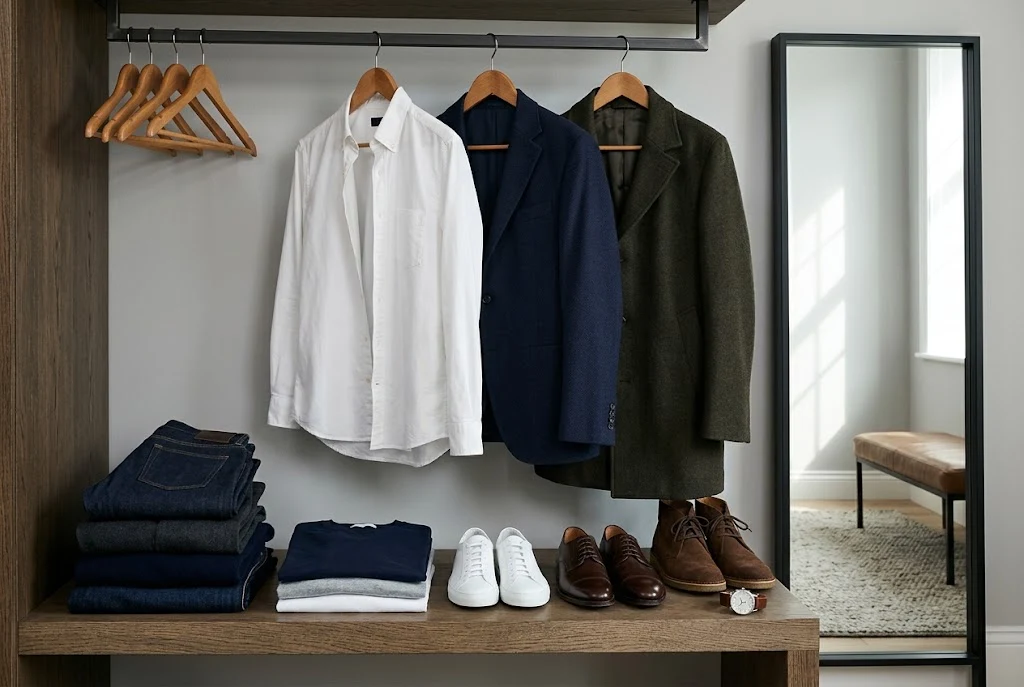
A well-built men’s wardrobe does not need to contain dozens of outfits. The most useful wardrobe is usually based on versatile pieces that can be combined for work, weekends, dinners, social occasions and different seasons.
Wardrobe essentials give you a reliable foundation. Instead of wondering what to wear or buying something new for every occasion, you can create different looks by changing combinations, footwear, layers and accessories.
There is no single list that every man needs to follow. Your ideal wardrobe depends on your lifestyle, profession, personal style and the amount of time you spend in formal or casual settings. However, several versatile pieces are worth considering when building a practical wardrobe.
What Are Men’s Wardrobe Essentials?
Wardrobe essentials are reliable clothing and accessories that can be worn regularly and combined with other pieces in different ways.
Good essentials are usually:
- Versatile
- Comfortable
- Easy to coordinate
- Appropriate for several occasions
- Suitable for your lifestyle
- Durable enough for regular use
An item does not automatically become an essential because it appears on a fashion checklist. If you never wear it, it does not belong in your core wardrobe.
1. A Good Pair of Jeans
A reliable pair of jeans is one of the most versatile items in a man’s wardrobe.
Choose a fit that feels comfortable and suits your preferred style. Straight, slim, tapered and relaxed cuts can all work depending on your proportions and personal preference.
For maximum versatility, consider a clean pair without excessive distressing. Dark denim can be dressed up more easily, while lighter washes usually create a more casual appearance.
Jeans can be combined with T-shirts, shirts, knitwear, jackets and trainers, making them useful across much of the year.
2. Tailored Trousers or Chinos
Jeans cannot cover every situation. A pair of tailored trousers or chinos gives you an alternative when you want to look more polished.
Chinos can work particularly well for smart-casual outfits, while tailored trousers can provide a more formal appearance.
Try them with:
- Oxford-style shirts
- Polo shirts
- Fine-knit jumpers
- Blazers
- Plain T-shirts
- Smart shoes or clean trainers
Neutral colours such as navy, grey, beige and stone can make these pieces easier to coordinate.
3. Plain T-Shirts
A collection of well-fitting plain T-shirts can form the foundation of everyday outfits.
Start with colours that work naturally with your wardrobe, such as:
- White
- Black
- Navy
- Grey
- Cream
You do not need every colour. A few reliable options can be enough.
A plain T-shirt can be worn with jeans and trainers for a casual look or paired with tailored trousers and a blazer for a more polished smart-casual outfit.
4. A Smart Shirt
A smart shirt is useful for occasions when a T-shirt or polo feels too casual.
An Oxford-style shirt is particularly versatile because it can work with jeans, chinos and tailored trousers.
White and pale blue are classic choices, but patterns and other colours can add personality once you have established your basics.
Choose a fit that allows comfortable movement without excessive fabric around the body.
5. Polo Shirts
A polo shirt sits comfortably between a T-shirt and a formal shirt.
It can be useful for:
- Smart-casual offices
- Weekend lunches
- Casual dinners
- Travel
- Social occasions
Pair a polo with chinos and loafers for a polished look, or wear it with jeans and trainers for something more relaxed.
6. A Fine-Knit Jumper
Fine knitwear is particularly useful for UK wardrobes because it provides an additional layer without the bulk of heavier knitwear.
A simple jumper can be worn over a shirt, with jeans or chinos, under a blazer or beneath a coat.
Neutral colours are versatile, while a deeper seasonal colour can introduce more personality.
7. A Versatile Blazer
A blazer can turn an otherwise casual outfit into a more polished look.
You do not need to wear it with matching suit trousers. Try combining it with:
- Dark jeans
- Chinos
- Tailored trousers
- A plain T-shirt
- A polo shirt
- A fine-knit jumper
A softly structured blazer can be particularly useful because it can move between professional and social settings.
For more guidance on combining smart and relaxed clothing, read our guide to smart casual outfits.
8. A Proper Suit
Even men who rarely wear formal clothing can benefit from owning at least one well-fitting suit.
It can be useful for:
- Weddings
- Job interviews
- Formal dinners
- Professional events
- Funerals
- Other formal occasions
Navy or charcoal can provide a versatile starting point.
Fit is particularly important with tailoring. If the suit fits poorly, even a high-quality garment can look untidy.
9. A Practical Coat
A good coat is an important part of a UK wardrobe because outerwear is often worn regularly throughout autumn and winter.
Depending on your needs, consider:
- A wool coat
- A trench coat
- A waterproof jacket
- A padded winter coat
- A smart everyday coat
Choose based on your actual routine rather than buying an outer layer purely because it is fashionable.
10. A Lightweight Jacket
A lightweight jacket can bridge the gap between knitwear and heavy outerwear.
Useful options might include:
- Overshirts
- Lightweight bomber jackets
- Casual field jackets
- Denim jackets
- Unstructured jackets
- Lightweight tailored jackets
The right choice depends on your personal style and the way you spend your time outdoors.
11. Clean Everyday Trainers
Trainers are no longer limited to sportswear. Simple, clean designs can work with many casual and smart-casual outfits.
Try them with:
- Jeans
- Chinos
- Tailored trousers
- Casual shirts
- Polo shirts
- Relaxed tailoring
Keep them clean and in good condition if you want them to contribute to a polished appearance.
12. Smart Shoes
A pair of smart shoes gives you an option when trainers are not appropriate.
Depending on your wardrobe, you could consider:
- Derby shoes
- Oxford shoes
- Loafers
- Monk-strap shoes
- Smart leather boots
A versatile dark colour can work with formal trousers, suits and some smart-casual combinations.
13. Chelsea or Ankle Boots
Boots can be particularly useful during the cooler months and can bridge the gap between casual and formal footwear.
Chelsea boots, for example, can be paired with jeans, tailored trousers and some smart-casual outfits.
Choose a style that is comfortable and practical for your everyday routine.
14. Smart Casual Shorts
For warmer weather, a pair of well-fitting shorts can be useful.
Choose a length and cut that feels comfortable and works with your personal style.
For a more polished summer look, combine shorts with a polo shirt, lightweight shirt and clean trainers or suitable casual footwear.
Always consider the venue because shorts may not be appropriate for formal settings.
15. Comfortable Knitwear
A heavier jumper can provide warmth during colder UK months.
Useful styles include:
- Crew-neck jumpers
- V-neck jumpers
- Half-zip knitwear
- Cardigans
- Chunkier textured knitwear
Layer heavier knitwear over shirts or T-shirts depending on the temperature and desired appearance.
16. A Versatile Overshirt
An overshirt is a useful layering piece that can work between seasons.
Wear it open over a T-shirt, buttoned with chinos or layered beneath a coat when temperatures fall.
Its relaxed structure makes it particularly useful for casual and smart-casual wardrobes.
17. A Quality Belt
A belt is both functional and an easy way to make an outfit look more complete.
Consider having at least one versatile belt that works with the shoes you wear most often.
For formal clothing, a simpler leather design is usually appropriate. Casual outfits can accommodate a wider range of materials and styles.
18. A Practical Everyday Bag
A suitable bag can be particularly useful for commuting, work and travel.
Depending on your routine, consider:
- A backpack
- A leather or structured work bag
- A messenger bag
- A compact crossbody bag
- A practical weekend bag
Choose based on what you actually carry rather than selecting a bag purely for appearance.
19. A Simple Watch
A watch can act as a practical accessory while adding another detail to an outfit.
A simple design can work with both casual and smart clothing, making it more versatile than a highly specialised style.
You do not need an expensive watch to make an outfit feel polished.
20. Sunglasses
Sunglasses are useful for bright weather and can also complement an outfit.
Choose a frame that feels comfortable and suits your personal preferences. The best pair is one you will actually wear regularly.
How Many Clothes Does a Man Really Need?
There is no universal number.
The ideal wardrobe depends on:
- Your job
- Your social life
- Your hobbies
- Your climate
- Your laundry routine
- Your personal style
- How often you travel
A man working in a formal office may require more shirts and tailoring than someone working remotely. Someone who spends most weekends outdoors may need more practical clothing than someone living a mostly urban lifestyle.
The goal should be usefulness rather than reaching a particular number of garments.
Build Your Wardrobe Around Your Lifestyle
Your clothes should reflect the situations you actually experience.
If your daily routine involves commuting, prioritise comfortable footwear and practical outerwear.
If you work in a formal environment, invest more attention in suits, shirts, smart shoes and professional layers.
Also, if your lifestyle is mostly casual, focus on quality jeans, T-shirts, knitwear, overshirts, trainers and smart-casual pieces.
A wardrobe becomes more useful when it supports your real life rather than an imaginary one.
Use a Capsule Wardrobe Approach
You do not need to adopt an extremely minimalist wardrobe to benefit from capsule wardrobe principles.
The basic idea is to choose pieces that coordinate easily and can be worn in several combinations.
For example, one navy blazer could work with jeans, chinos and tailored trousers. A fine-knit jumper could work with all three. A pair of clean trainers could then create a more relaxed appearance, while loafers or smart shoes could make the outfit more polished.
This approach can reduce unnecessary purchases while making it easier to choose an outfit.
Our guide to building a capsule wardrobe explains how to create a more versatile clothing collection.
How to Choose Colours for a Men’s Wardrobe
Neutral colours provide a useful foundation because they can be combined easily.
Consider colours such as:
- Navy
- Grey
- Black
- White
- Cream
- Beige
- Brown
- Olive
You can then introduce brighter colours through shirts, knitwear, jackets or accessories.
A coordinated palette can make a smaller wardrobe feel considerably more versatile.
How to Make Basic Clothes Look More Stylish
Basic clothing does not have to produce boring outfits.
You can create variety by changing:
- Layers
- Footwear
- Accessories
- Colour combinations
- Proportions
- Textures
For example, jeans and a T-shirt can look completely different with trainers and an overshirt compared with loafers and a blazer.
Learning how to style the same pieces in different ways can be more valuable than constantly buying new clothes.
How to Build a Smart Casual Men’s Wardrobe
Smart casual is one of the most useful dress codes for modern wardrobes because it can cover a wide range of situations.
A simple foundation could include:
- Dark jeans
- Chinos
- Tailored trousers
- Oxford-style shirts
- Polo shirts
- Fine-knit jumpers
- A blazer
- Loafers or smart shoes
- Clean trainers
These pieces can be combined in different ways depending on how formal the occasion is.
For additional ideas, see our guide to looking stylish while staying comfortable.
How to Shop for Men’s Wardrobe Essentials on a Budget
You do not need to buy everything at once.
Start by identifying the biggest gaps in your wardrobe.
If you already have several T-shirts but lack smart shoes for formal occasions, buying another T-shirt is unlikely to improve your wardrobe.
Before purchasing anything, ask:
- Does it fit well?
- Will I wear it regularly?
- Does it work with clothes I already own?
- Can I create several outfits with it?
- Is it appropriate for my lifestyle?
- Would I still buy it without a discount?
This can help reduce impulse purchases and make your clothing budget work harder.
When Is It Worth Spending More?
It can make sense to spend more selectively on items you use frequently.
Potential investment areas include:
- Everyday shoes
- Winter coats
- Work trousers
- Frequently worn knitwear
- A suit
- Everyday bags
However, price alone does not guarantee quality. Consider fabric, construction, comfort, fit and expected use before deciding how much to spend.
Look After Your Clothes
Taking care of your wardrobe can reduce the need for frequent replacements.
Follow garment care instructions, repair small problems when practical and store clothes appropriately.
Keep shoes clean, avoid unnecessary washing and pay attention to stains or loose buttons before small problems become larger ones.
Good maintenance can help even relatively affordable clothing maintain a better appearance.
Wardrobe Essentials for Different Seasons
Spring
Use lightweight jackets, overshirts, fine knitwear, jeans, chinos and transitional footwear.
Summer
Choose breathable shirts, T-shirts, polo shirts, lightweight trousers, suitable shorts and comfortable warm-weather footwear.
Autumn
Bring knitwear, boots, jackets and heavier layers into regular rotation. Layering becomes particularly useful.
Winter
Prioritise warm coats, heavier knitwear, practical boots and layers that work with colder UK weather.
Common Men’s Wardrobe Mistakes
Owning Too Many Similar T-Shirts
Having a few reliable T-shirts is useful, but buying endless variations of the same item can prevent you from filling more important wardrobe gaps.
Ignoring Fit
A simple, well-fitting outfit can look much more polished than expensive clothing that does not fit correctly.
Buying Only for Trends
Trends can be enjoyable, but your core wardrobe should not depend entirely on short-lived fashion movements.
Neglecting Footwear
Worn-out shoes can undermine an otherwise good outfit. Keep your regular footwear clean and maintained.
Buying for Occasions That Never Happen
Your wardrobe should reflect your actual lifestyle. Do not spend heavily on clothing for situations you rarely encounter.
A Simple Men’s Wardrobe Checklist
When reviewing your wardrobe, check whether you have suitable clothing for:
- Everyday casual wear
- Smart-casual occasions
- Work
- Dinners
- Weddings
- Formal events
- Warm weather
- Cold weather
- Rainy UK conditions
- Travel
You do not need separate clothing for every category. The most useful essentials can often cover several situations.
Frequently Asked Questions
What are the most important wardrobe essentials for men?
Useful foundations include well-fitting jeans, chinos or tailored trousers, plain T-shirts, smart shirts, knitwear, a versatile blazer, a good coat, everyday trainers, smart shoes and at least one suitable formal outfit.
How many clothes should a man own?
There is no fixed number. Your wardrobe should reflect your work, lifestyle, personal style, climate and how often you need different types of clothing.
What colours should every man have in his wardrobe?
Navy, grey, black, white, cream, beige and brown are versatile starting points. However, you should choose colours that you genuinely enjoy wearing.
Is a blazer an essential for men?
A blazer can be extremely useful if you regularly attend smart-casual or professional occasions. If your lifestyle is completely casual, another type of jacket may be more useful.
Does every man need a suit?
A suit can be useful even if you rarely wear formal clothing because weddings, interviews, professional events and other occasions may require one.
How can men build a wardrobe on a budget?
Start with genuine gaps, choose versatile pieces and avoid unnecessary impulse purchases. Prioritise fit, comfort and how often you expect to wear an item rather than simply choosing the cheapest option.
Conclusion
The best men’s wardrobe is not necessarily the biggest one. It is a collection of clothing that works for your actual lifestyle and gives you enough flexibility to dress appropriately for different situations.
Start with versatile foundations such as jeans, trousers, shirts, T-shirts, knitwear, suitable footwear and practical outerwear. Add more specialised pieces only when your lifestyle requires them.
Focus on fit, comfort, coordination and versatility rather than buying something simply because it is fashionable. With the right essentials, you can create more outfits, reduce unnecessary shopping and make getting dressed considerably easier.
