

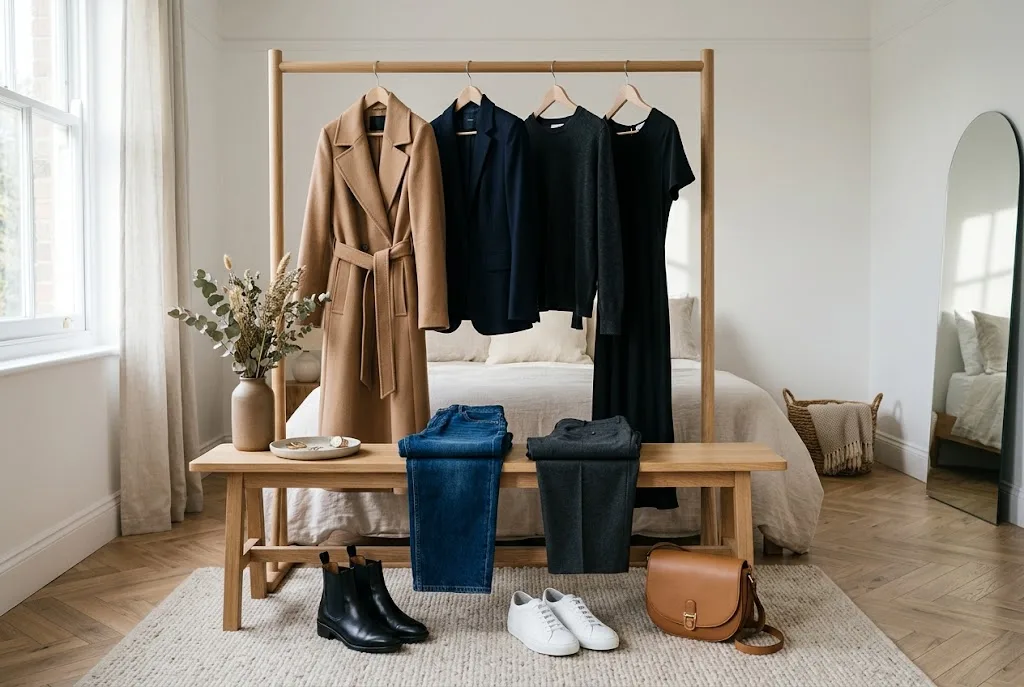
A good wardrobe does not need to be packed with clothes. The most useful collection is often built around a smaller number of versatile pieces that can be combined for work, weekends, dinners, occasions and changing seasons.
Wardrobe essentials provide the foundation for creating outfits without constantly buying something new. The right pieces can be dressed up or down, layered for UK weather and adapted to different parts of your lifestyle.
There is no universal list that every woman needs to follow. Your ideal wardrobe depends on your work, lifestyle, personal style, climate and the occasions you regularly attend. However, a few versatile categories are worth considering when building a practical wardrobe.
What Are Wardrobe Essentials?
Wardrobe essentials are reliable clothing and accessories that can be worn regularly and combined with other pieces in different ways.
They are usually:
- Versatile
- Easy to coordinate
- Suitable for multiple occasions
- Comfortable enough to wear regularly
- Compatible with your personal style
- Practical for your lifestyle
An essential does not have to be a basic white T-shirt or a classic blazer. If you rarely wear those items, they are not essential for your wardrobe.
The best wardrobe essentials are the pieces you repeatedly reach for.
1. A Well-Fitting Pair of Jeans
A reliable pair of jeans can form the foundation of countless casual and smart-casual outfits.
Look for a style that fits comfortably through the waist and works with the footwear you normally wear.
Depending on your personal style, you might prefer:
- Straight-leg jeans
- Wide-leg jeans
- Bootcut jeans
- Relaxed-fit jeans
- Slim or tapered jeans
Choose a wash that works with most of your wardrobe. Dark denim can feel slightly smarter, while lighter washes can create a more relaxed appearance.
2. A Pair of Tailored Trousers
Jeans cannot cover every occasion. A pair of well-fitting tailored trousers can immediately give your wardrobe more flexibility.
They can be worn with:
- A blouse for work
- A T-shirt for smart casual dressing
- A jumper during colder months
- A blazer for a polished outfit
- Smart footwear for dinners or events
Neutral shades such as black, navy, grey or beige can make styling easier, but choose a colour that fits naturally with your existing wardrobe.
3. A Plain T-Shirt
A simple T-shirt may be one of the hardest-working pieces in a modern wardrobe.
Choose a cut and neckline that you genuinely enjoy wearing. A high-quality plain T-shirt can be styled casually with denim or made more polished with tailored trousers and a blazer.
Useful colours might include:
- White
- Black
- Grey
- Navy
- Cream
You do not need all of them. Start with the colours that work best with your wardrobe.
4. A Versatile Blouse or Smart Shirt
A blouse or smart shirt can bridge the gap between everyday and formal dressing.
It can be worn with jeans for a relaxed outfit or paired with tailored trousers or a skirt for work.
When choosing one, consider the fabric, neckline, sleeve length and ease of care. The best option is one you will actually enjoy wearing.
5. A Fine-Knit Jumper
Fine knitwear is particularly useful in the UK because it can provide warmth without creating excessive bulk.
A lightweight jumper can be worn:
- Over a shirt
- With jeans
- With tailored trousers
- Under a blazer
- With a skirt
- Under a coat
Neutral knitwear tends to offer the most versatility, while a coloured or patterned jumper can introduce personality.
6. A Versatile Blazer
A blazer can instantly make a simple outfit look more polished.
It does not have to be part of a matching suit. Try wearing a blazer with jeans, a plain T-shirt, a blouse or tailored trousers.
A relaxed or softly structured blazer can be especially versatile because it can work across professional and casual settings.
For more guidance on combining polished and relaxed pieces, see our article on how to dress smart casual for any occasion.
7. A Little Black Dress or Versatile Occasion Dress
A versatile dress can make dressing for dinners, parties and other occasions considerably easier.
It does not necessarily need to be black. The most important qualities are that it fits well, feels comfortable and can be styled in different ways.
You can change its appearance with:
- Different shoes
- A blazer
- A cardigan
- Jewellery
- A structured bag
- A scarf or wrap
This makes one dress useful across multiple occasions rather than reserving it for a single event.
8. A Practical Coat
A coat is more than a seasonal fashion purchase in the UK. It is often one of the most visible parts of an outfit for several months of the year.
Choose a coat based on your actual lifestyle and local weather.
Depending on your needs, useful options can include:
- A tailored wool coat
- A trench coat
- A practical waterproof coat
- A padded winter coat
- A smart everyday coat
If you want one coat to cover multiple situations, a versatile neutral style can be particularly useful.
9. Comfortable Everyday Trainers
A pair of clean, comfortable trainers can work with far more outfits than many people expect.
They can be paired with:
- Jeans
- Tailored trousers
- Casual dresses
- Skirts
- Relaxed tailoring
For maximum versatility, consider a simple design that complements rather than dominates your outfits.
10. Smart Shoes or Loafers
Every wardrobe benefits from footwear that can make an outfit more polished.
Depending on your style, this could be loafers, flats, ankle boots, heeled shoes or another sophisticated option.
Choose something comfortable enough to use when you genuinely need it. There is little value in owning beautiful shoes that you cannot comfortably wear for more than a few minutes.
11. Ankle Boots
Ankle boots can be particularly useful for a UK wardrobe because they work across much of the year.
They can be paired with:
- Jeans
- Tailored trousers
- Midi skirts
- Dresses
- Knitwear
- Coats
Choose a heel height and shape that suit your lifestyle. A low or medium heel can provide versatility without sacrificing practicality.
12. A Versatile Skirt
A skirt can add variety to a wardrobe built largely around trousers and jeans.
A midi skirt is particularly adaptable because it can be styled casually or more formally.
Try pairing it with:
- A plain T-shirt
- A fine-knit jumper
- A blouse
- A blazer
- Trainers
- Boots
Choose a silhouette that feels comfortable and fits naturally with your personal style.
13. A Comfortable Cardigan
A cardigan is a useful layering piece for changing UK temperatures.
It can be worn over T-shirts, dresses, blouses and shirts, making it useful across several seasons.
Neutral cardigans are easy to coordinate, while brighter colours can make a simple outfit more distinctive.
14. A Lightweight Layering Jacket
A lightweight jacket can provide another option between a cardigan and a heavy coat.
Depending on your style, consider an overshirt, casual jacket, denim jacket, bomber or lightweight tailored jacket.
The best option depends on where you live, how you travel and how much time you spend outdoors.
15. A Versatile Handbag
A practical everyday bag can make a major difference to your wardrobe.
Look for one that can hold the items you regularly carry without becoming unnecessarily large.
Useful considerations include:
- Size
- Strap length
- Comfort
- Organisation
- Durability
- Colour
A neutral everyday bag can work across more outfits, while a smaller statement bag can provide an optional finishing touch for evenings and occasions.
16. A Smart Belt
A belt is a small accessory, but it can help bring an outfit together.
It can be worn with jeans, trousers, skirts and certain dresses. Matching your belt with your shoes can create a coordinated appearance, although contrasting combinations can also work.
Choose a simple design if versatility is your priority.
17. Simple Jewellery
Jewellery can change the appearance of a basic outfit without requiring you to buy new clothes.
Depending on your preferences, useful pieces might include:
- Stud earrings
- A simple necklace
- A watch
- A bracelet
- Simple rings
You can keep jewellery understated for everyday outfits and introduce stronger statement pieces when dressing for an evening or special occasion.
18. A Scarf
A scarf can be both practical and stylish, particularly during cooler UK months.
It can add colour, texture and another layer to an otherwise simple outfit.
Choose a scarf that works with your coat and everyday clothing so you are more likely to use it regularly.
19. Comfortable Loungewear
Not every wardrobe essential needs to be designed for going out.
Comfortable loungewear can be useful for working from home, relaxing, travelling or quiet weekends.
Choose pieces that are comfortable while still being presentable enough for your everyday routine.
20. Suitable Occasionwear
It is useful to have at least one outfit that can be adapted for formal or special occasions.
This might be:
- A sophisticated dress
- A tailored trouser suit
- An elegant jumpsuit
- A coordinated skirt and top
- A versatile formal outfit
Rather than buying something new for every event, choose pieces that can be restyled with different accessories, shoes and layers.
How Many Wardrobe Essentials Do You Actually Need?
There is no ideal number of wardrobe essentials.
Your requirements will depend on:
- Your profession
- How often you go out
- Your climate
- Your laundry routine
- Your hobbies
- Your personal style
- How often you travel
Someone who works in a formal office may need more tailored clothing than someone who works remotely. Someone who regularly attends events may need more occasionwear than someone with a casual lifestyle.
The objective is not to own a specific number of items. It is to have enough useful clothing for your real life.
How to Choose Wardrobe Essentials That Actually Suit You
Do not buy an item simply because it appears on a generic “must-have” list.
Before buying, ask:
- Would I wear this regularly?
- Does it fit comfortably?
- Does it work with clothes I already own?
- Can I style it for more than one occasion?
- Does it suit my lifestyle?
- Do I genuinely like the way it looks?
If the answer is no, it may not be an essential for you.
Choose Quality Where It Matters
You do not need to spend a fortune on every wardrobe item.
However, it can make sense to pay more attention to pieces you wear frequently.
Potential areas to prioritise include:
- Everyday footwear
- Winter coats
- Jeans
- Work trousers
- Frequently worn knitwear
- Everyday bags
Look at construction, fabric, comfort and expected use rather than assuming a higher price automatically means better quality.
Build a Wardrobe Around Your Lifestyle
Your wardrobe should support the life you actually live.
If you commute by public transport, comfortable footwear and practical outerwear may be particularly important.
If you work in an office, tailored trousers, blouses and smart layers may deserve more space.
Also, if you work from home, comfortable clothing that can easily become presentable for an unexpected meeting may be more useful.
If you regularly attend social events, versatile occasionwear can provide more value than buying additional casual basics.
Use a Capsule Wardrobe Approach
You can use the principles of a capsule wardrobe without limiting yourself to an extremely small number of clothes.
The basic idea is to choose pieces that coordinate easily and can be worn in multiple combinations.
For example, one blazer might work with jeans, tailored trousers, a skirt and a dress.
One pair of ankle boots might work with denim, trousers and several dresses.
One neutral jumper might work with jeans, a skirt and tailored trousers.
This type of versatility can help reduce unnecessary shopping and make your wardrobe easier to manage.
For a more detailed approach, read our guide on how to build a capsule wardrobe that actually works.
How to Make Wardrobe Essentials Feel Less Boring
Essentials do not have to mean plain or personality-free.
Once you have a reliable foundation, introduce character through:
- Colour
- Prints
- Texture
- Jewellery
- Handbags
- Scarves
- Footwear
- Layering
A neutral wardrobe can be transformed by one colourful coat or statement accessory. Similarly, a simple outfit can feel more distinctive when different textures are combined.
How to Organise Your Wardrobe Essentials
Keeping your wardrobe organised makes it easier to see what you actually own.
Group clothing by category or type and make sure frequently worn items are easy to access.
At the beginning of each season, review your wardrobe and identify:
- Items you wear regularly
- Items that need repair
- Items that no longer fit
- Items you have not worn for a long time
- Genuine gaps that need filling
This can help prevent unnecessary purchases.
How to Shop for Wardrobe Essentials on a Budget
Start with the gaps rather than shopping without a plan.
If you already have three good pairs of jeans but no suitable coat, buying another pair of jeans will not improve your wardrobe as much as finding the coat you actually need.
Also consider cost per wear. A moderately priced item that becomes a regular part of your wardrobe may provide more value than an expensive piece worn only once.
Pre-owned clothing and charity shops can also be useful, particularly for coats, blazers, knitwear and accessories.
Wardrobe Essentials for Different Seasons
Spring
Focus on lightweight layers, transitional jackets, fine knitwear, jeans, trousers and versatile footwear.
Summer
Consider breathable tops, lightweight trousers, dresses, skirts, comfortable sandals or other warm-weather footwear and a lightweight layer for cooler evenings.
Autumn
Bring knitwear, boots, jackets and transitional coats into regular rotation. Layering becomes especially useful.
Winter
Prioritise warm coats, knitwear, practical footwear and layers that can handle colder UK temperatures.
Common Wardrobe Mistakes
Buying Too Many Basics
Basics are useful, but having large quantities of nearly identical clothing can take up space without adding much versatility.
Ignoring Your Lifestyle
A wardrobe filled with formal clothing is not useful if most of your life is casual, and the opposite is also true.
Buying Trends Instead of Gaps
Trendy pieces can be enjoyable, but they should not replace the practical items your wardrobe genuinely lacks.
Choosing Uncomfortable Shoes
Footwear needs to work for your real routine. Style should not require you to spend an entire day in pain.
Keeping Clothes That No Longer Work
If an item no longer fits, is damaged beyond reasonable repair or does not reflect your current lifestyle, keeping it may make your wardrobe harder to use.
A Simple Wardrobe Essentials Checklist
When reviewing your wardrobe, consider whether you have suitable options for:
- Everyday casual outfits
- Work or professional settings
- Smart-casual occasions
- Dinners and social events
- Formal occasions
- Warm weather
- Cold weather
- Rainy UK weather
- Comfortable days at home
- Travel
You do not need a separate outfit for every category. The best essentials can often cover several situations.
Frequently Asked Questions
What are the most important wardrobe essentials for women?
Useful foundations can include well-fitting jeans, tailored trousers, plain tops, knitwear, a versatile blazer, a practical coat, suitable everyday footwear and at least one adaptable occasion outfit.
How many wardrobe essentials should a woman own?
There is no fixed number. The right amount depends on your lifestyle, work, climate, personal style and how often you do laundry.
What colours are best for wardrobe essentials?
Neutral colours such as navy, black, grey, cream, beige and brown are easy to combine, but the best colours are those you enjoy wearing and that work with your existing wardrobe.
Should wardrobe essentials be expensive?
No. Focus on fit, comfort, quality and versatility. Spend more selectively on pieces you expect to wear frequently rather than assuming every essential needs to be expensive.
How can I make basic wardrobe essentials look stylish?
Use layering, accessories, colour, texture and different footwear to change the appearance of simple clothing. A well-fitting basic can also look polished when combined thoughtfully.
What should I buy first when building a wardrobe?
Start with the items that fill the biggest gaps in your everyday life. A versatile pair of trousers, comfortable footwear, useful outerwear and a few coordinating tops can provide a strong foundation.
Conclusion
The best wardrobe essentials are not necessarily the pieces that appear on every fashion checklist. They are the clothes you can rely on, wear comfortably and combine with other items in your wardrobe.
Start with your lifestyle, identify genuine gaps and choose versatile pieces that work across multiple occasions. Prioritise fit and comfort, look after what you already own and add personality through colour, accessories and styling.
A thoughtful wardrobe does not need to be enormous. With the right essentials, you can create more outfits, shop more intentionally and feel confident about what to wear throughout the year.
